


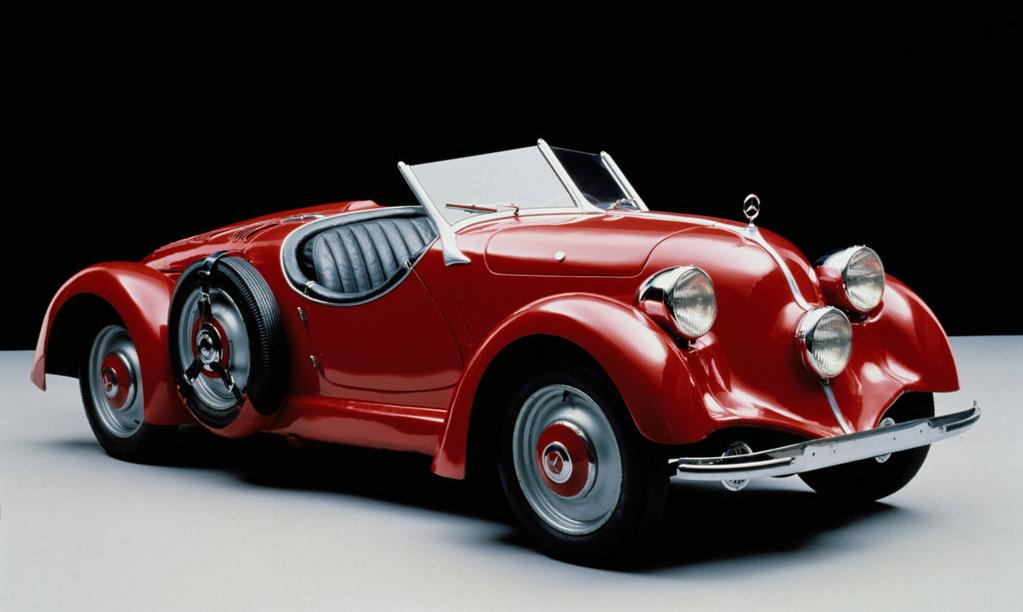
The Mercedes-Benz 230 convertible was produced from 1937 to 1941.
1 engine (2,2 liters / 55 hp) is on Histomobile.
19324 units produced.
Specifications performance
Top speed of 72 mph engine typedrivetrain: Water-cooled, sidevalve, 6-cylinder displacement 2,229 cc (2.23 d power rating 55 hp transmission 4-speed manual chassis: Cruciform oval tubing; Front independent suspension by transverse leaf springs; Independent rear suspension by swing axle; 4-wheel drum brakes; 3,234 lbs.
About vehicle
Early emperors those early models were succeeded by the 170, first shown at the 1931 paris salon. The 170 was the inaugural car of a long dynasty. With a lowered chassis and four-wheel independent suspension, the 170 was. The first mercedes with swing-axle rear suspension and hydraulic brakes. Its engine was rather less advanced a simple flathead 1.7-litre unit. enlarged lineup in 1933, the 170 was joined by the more powerful 200 series, available with normal or long chassis. After 1936, when the 170 was overshadowed by the new 170v with its cruciform tubular chassis, the 200 became the 230, with the cars swept volume increased to 2,229 cc. The 230 was offered with a variety of factory-built coachwork from the mercedes coachworks shops at sindelfingen. They-were all mounted on the long chassis (produced until 1941). A short-chassis version was made available only in 1937, with a choice of two cabriolet styles, a roadster, a coupe and a sedan.
The cabriolet b body style, with either four or five seats and roll-down rear windows, was used on several mercedes-benz models from the thirties to the fifties.

The 2545 cc overhead valve, 4 cylinder engine employed the Bosch diesel injection system and produced 45 bhp (34 kW) at 3000 rpm. The car weighed approximately 1530 kg and could attain a top speed of 95 km/h.
The chassis was based on contemporary Mercedes technology and had transverse leaf spring independent front suspension and swing axles at the rear. The brakes were hydraulic. A range of body types were made including saloons, landaulettes and cabriolets.
Two series were manufactured, 170 pullman-landaulets used only as taxis based on the W21 chassis, called the Nullserie from 1936 to 1937, with a three speed plus overdrive transmission, without syncromesh on the first gear, and, from 1937 on, the regular production 260D based on the W143 chassis, with a four speed fully synchronized transmission.
A surviving example of the car is displayed at the Mercedes-Benz museum in Germany.

The 500K used the same independent suspension setup as had been introduced on the 380, with a double wishbone front axle, double-joint swing axle at the rear, and separate wheel location, coil springs and damping, a world first.
Consequently it was a more comfortable and better handling car than Mercedes' previous S/SS/SSK generation of roadsters from the 1920s, and offered greater appeal to buyers, particularly the growing number of well-heeled female drivers of the time.

1935 Mercedes-Benz Sport Roadster 150 H (Heckmotor)
Part of the 130h, 150h and 170h Heckmotor (Rear Engine) series of the 1930s. 1.7-liter engine
When the 130 sedan appeared in 1934, it was the smallest production Mercedes in the company's history, as well as the first to carry its engine in the tail. The potential to build a sports car out of the innovative underpinnings of the humble sedan must have occurred to Mercedes' engineers from the beginning, because by the end of the year, they had produced a 150 Sports Saloon to compete in a 2,000-kilometer rally across Germany. One year later, the thinking behind the Sports Saloon gave birth to the 150 Sports Roadster.
While the 130 had a 1.3-liter, water-cooled four hung out behind the rear axle, the 150's 1.5-liter four was turned around 180 degrees, its midships location giving the chassis better balance and more stable handling. In place of the 1.3-liter's sidevalve arrangement, the 1.5 had overhead valves, and produced about 55 horsepower with a Solex two-barrel carburetor and a compression ratio of 7.1:1.
The chassis employed the tubular backbone developed for the 130, with independent suspension by transverse leaf spring in the front, and coil-sprung swing axles in the rear. Behind where the seats would be, the chassis forked to cradle the engine and transaxle. To provide adequate cooling, a squirrel-cage blower moved air through the rear-mounted radiator.
The rear-engine configuration allowed for wind-cheating bodywork. Unusual touches, such as the single high-beam headlamp and the twin spare tires mounted behind the rear-hinged doors, were blended with traditional sports-car elements like the swept vee windshield and the gently tapering boattail. Some called it beautiful, others called it ungainly, and all agreed it was distinctive. The car weighed in at 2,160 pounds, giving it a power-to-weight ratio of nearly 40 pounds per horsepower. Aerodynamics helped it to reach a top speed of 78 miles per hour.
Although Mercedes had been hoping for volume production, the Sports Roadster suffered some disadvantages in the marketplace. The mid-rear engine configuration and short wheelbase ruled out any possibility of a back seat, while the 16-gallon gas tank mounted in the car's nose ate into already scarce luggage space. And the price, at 6,600 deutschemarks, was nearly double that of a basic 130 sedan.
Despite the factory's best efforts to promote the 150 as "a spirited sports car" with acceleration that was nearly equal to that of larger, supercharged cars, buyers were not interested. The 150 Sports Roadster remained in the catalogue through 1936, but few were sold. Even Mercedes-Benz doesn't know how many were produced: One record says that 20 examples were built, while another puts the number at five. There is proof of the sale of just two cars, one of which was reacquired by Daimler AG in the 1950s.


Model history
 the W123 four-door versions in January, 1976. While there were some technical similarities to their predecessors, the new models were larger in wheelbase and exterior dimensions. The styling was also updated, although stylistic links with the W115 were maintained. Initially, all models except 280/280E featured quad unequal-size round headlights and the latter large rectangular units. When facelifted these units became standard across the range. All W115 engines were carried over, with the 3 litre 5-cylinder diesel model being renamed from "240D 3.0" to "300D" (as it had already been called before in North American markets). The only new engine was the 250's 2525 cc inline-six (Type M123, a short-stroke version of the 2.8 litre six Type M110) that replaced the old 2496 cc Type M114 six.
In the spring of 1976, a coupé version was introduced on a shorter wheelbase than the saloon (2,710 mm (106.7 in) versus 2,795 mm (110.0 in)) for the saloon. This W123C/CE was available as a 230C (later 230CE) and as a 280C/CE in most markets; in North America there were additional 300CD versions with naturally aspirated, later turbocharged 3 litre diesel engines.
It is a tribute to the car's instant popularity – and possibly to the caution built into the production schedules – that nine months after its introduction, a black market had developed in Germany for Mercedes-Benz W123s available for immediate delivery.[4] Customers willing to order new cars from their local authorized dealer for the recommended list price faced waiting times in excess of twelve months. Hardly used models available at once were commanding a premium over the new price of around DM 5,000.
From August, 1977, long wheelbase versions (3,425 mm (134.8 in)) were produced. These were available as 7/8 seater saloons with works bodies or as a chassis with complete front body clip, the latter serving as the base for ambulance and hearse bodies by external suppliers like Binz or Miesen. These "Lang" versions could be ordered as 240D, 300D and 250 models.
At the Frankfurt Auto Show in September, 1977 the W123T estate was introduced; the T in the model designation stood for "Touring and Transport". All engines derivative except "200TD" were available in the range. T production began in March, 1978 in Mercedes' Bremen factory.
In early 1979, the diesel models power output was increased; power rose from 55 PS (40 kW; 54 hp) to 60 PS (44 kW; 59 hp) in the 200D, from 65 PS (48 kW; 64 hp) to 72 PS (53 kW; 71 hp) in the 240D and from 80 PS (59 kW; 79 hp) to 88 PS (65 kW; 87 hp) in the 300D; at the same time, the 220D went out of production.
The first Mercedes turbo diesel production W123 appeared in September, 1979. This was the 300 TD Turbodiesel, available with automatic transmission only. In most markets, the turbocharged 5-cylinder 3 litre diesel engine (Type OM617) was offered only in the T body style, while in North America it was also available in saloon and coupé guises.
June 1980 saw the introduction of new 4-cylinder petrol engines (Type M102). A new 2 litre four with shorter stroke replaced the old M115, a fuel-injected 2.3 litre version of this engine (in 230E/TE/CE) the old carbureted 230. Both engines were more powerful than their predecessors.
In 1980/81 the carbureted 280 versions went out of production; the fuel-injected 280E continued to be offered.
In September, 1982, all models received a mild facelift. The rectangular headlights, previously fitted only to the 280/280E, were standardized across the board, as was power steering. Since February, 1982, an optional 5-speed manual transmission was available in all models (except 300 TD).
W123 production ended in January, 1986 with 63 T-models rolling out. Most popular single models were the 240D (455,000 built), the 230E (442,000 built) and the 200D (378,000 built).
W123 introduced innovations including ABS (optional from August, 1980), a retractable steering column and an airbag for the driver (optional from 1982).
Available options included MB-Tex (Mercedes-Benz Texturized Punctured Vinyl) upholstery or velour or leather upholstery, interior wood trim, passenger side exterior mirror (standard on T models), 5-speed manual transmission (European market only), 4-speed automatic transmission (standard in turbodiesel models), power windows with rear-seat switch cut-outs, vacuum powered central locking, rear-facing extra seats (station wagon only), Standheizung (prestart timer controlled engine heating), self locking differential, sun roof, air conditioning, climate control, "Alpine" horn (selectable quieter horn), headlamp wipers (European market only), Tempomat (cruise control), power steering (standard after 1982/08), seat heating, catalytic converter (available from 1984 for California only, from fall (autumn) 1984 also in Germany for the 230E of which one thousand were built).
Power (vacuum servo) assisted disc brakes were standard on all W123s.
source : wikipedia

 The C216 makes use of the Distronic Plus cruise control, which debuted on the 2007 S-Class. This system is able to bring the car to a complete stop, and accelerate again to the pre-set speed, to keep a pre-set distance away from the car ahead of it. This Mercedes-Benz CL has also debuted with the new Active NightVision program that enables drivers to view the conditions in front of the car despite the dark surroundings. As of the 2009 model year, Mercedes-Benz offers the CL550 in only 4Matic, while the CL600, CL63 AMG, and CL65 AMG are in the standard rear-wheel drive.
In 2007, 40 C216 CL65 AMG units have been sold as '40th Anniversary Edition', to celebrate AMG was founded 40 years earlier. Performancewise, the '40th Anniversary Edition' was a custom CL65 AMG. Changes to the car included an 'ONE OUT OF 40' badge near the COMAND controller, special upholstery and rooflining, and a special 'AMG Alubeam' paintfinish. Apart from the CL65 AMG '40th Anniversary Edition', only a small selection of showcars got an Alubeam finish, a special paint designed to gleam like liquid metal.
| Engine | Power | 0–100 km/h (62 mph) | Top speed | |
|---|---|---|---|---|
| CL500 | 5.5 L V8 | 285 kW (388 hp DIN) | 5.4 seconds | 250 km/h (155 mph) |
| CL500 4MATIC/CL550 4MATIC (USA) | 5.5 L V8 | 285 kW (388 hp DIN) | 5.4 seconds | 250 km/h (155 mph) |
| CL600 | 5.5 L V12 | 380 kW (517 hp DIN) | 4.6 seconds (4.1 seconds R&T) | 250 km/h (155 mph) |
| CL63 AMG | 6.2 L V8 | 386 kW (525 hp DIN) | 4.6 seconds | 250 km/h (155 mph) |
| CL63 AMG Performance Package (USA) | 6.2 L V8 | 386 kW (525 hp DIN) | 4.6 seconds | 300 km/h (186 mph) |
| CL65 AMG | 6.0 L V12 BiTurbo | 450 kW (612 hp DIN) | 4.4 seconds | 250 km/h (155 mph) |
Originally derived from the SL-Class roadster, it has since been based on the S-Class sedan. Known at first as the SEC and later S coupe, it was spun off into its own line and current name in 1998. The CL continues to follow the same development cycle as the S, though riding on a slightly shorter wheelbase and offering smaller selection of engines, mostly tending towards the high-powered of the range. The main competitors of the CL-Class are the Bentley Continental GT and the Ferrari Scaglietti.
The first generation The CL-class can most directly trace its roots back to the W126-chassis SEC-class of 1981-1991. The SEC wasn't itself a replacement for the R107 series
 SLC cars, which were essentially lengthened SL roadsters with a fixed roof and rear seat. The W126 SEC was more directly related to the S-Class sedans. The first generation SEC-Class came in four models: 380 SEC, 420 SEC, 500 SEC and 560 SEC. Like all subsequent models, the rear passenger volume of the SEC coupes was large enough to classify them as 2-door sedans by the SAE.
The second generation was the sleek, redesigned W140-chassis coupe of 1993-1999. Though the coupe’s physical appearance changed little over these years, the class
 underwent a name change several times. The V8 and V12 coupes were called the 500 SEC and 600 SEC, respectively, in 1993 only. The 600 SEC was the first V12 coupe ever offered by Mercedes-Benz. From 1994-1997, the model names were changed to the S500 coupe and the S600 coupe. The name "CL" was adopted in 1998, and the W140 coupes were called the CL500 and CL600 from 1998-1999.
The third generation of the CL is the W215-chassis coupé of 2000-2006. It is based on the 1999-2004/5 Mercedes-Benz S-Class, though it rides on an 8-inch (203 mm) shorter wheelbase. It is offered as four models: the V8-powered CL500, the supercharged V8-powered CL55 AMG, the V12-powered CL600, a 2001 limited-edition V12-powered CL63 AMG, and the rare bi-turbo V12-powered CL65 AMG. All models seat four.

The W215 production hit 46,800 units worldwide, of which 90% were V8 engines.
Engines
As with all major German manufacturers (except Porsche) Mercedes electronically limits their cars to 250 km/h (155 mph), except for the AMG models (option).
The justification for having two models with the same power (CL600 and CL55 AMG) is that the CL55 AMG is sportier and more responsive, while the more expensive CL600 is more luxurious with a smoother ride and an exceptional comfort. The CL65 AMG is made to order in very small numbers, and is the most powerful CL to date.
 | Engine | Power | Torque | 0-100 km/h (62 mph) | Top speed |
|---|---|---|---|---|---|
| CL500 | 5.0 L V8 | 225 kW (306 hp DIN) | 460 N·m (339 ft·lbf) | 6.3 seconds | 250 km/h (155 mph*) |
| CL600 (2000) | 5.8 L V12 | 270 kW (367 hp DIN) | 531 N·m (391 ft·lbf) | 5.9 seconds | 250 km/h (155 mph*) |
| CL600 (2003) | Turbocharged 5.5 L V12 | 368 kW (500 hp DIN) | 800 N·m (590 ft·lbf) | 4.8 seconds | 250 km/h (155 mph*) |
| CL55 AMG (2001) | 5.5 L V8 | 265 kW (360 hp DIN) | 530 N·m (391 ft·lbf) | 5.7 seconds | 250 km/h (155 mph*) |
| CL55 AMG (2003) | Supercharged 5.5 L V8 | 368 kW (500 hp DIN) | 700 N·m (516 ft·lbf) | 4.8 seconds | 250 km/h (155 mph*) |
| CL63 AMG | 6.3 L V12 | 327 kW (444 hp DIN) | 738 N·m (544 ft·lbf) | 4.4 seconds | 250 km/h (155 mph*) |
| CL65 AMG | Turbocharged 6.0L V12 | 450 kW (612 hp DIN) | 1000 N·m (737.6 ft·lbf) | 4.4 seconds | 250 km/h (155 mph*) |
 nd DaimlerChrysler's South African factory in East London. The very first W202 C-Class sedan was produced on June 1, 1993, and the second generation W203 C-Class rolled off the assembly line on July 18, 2000. The third generation W204 C-Class was launched in 2007. The C-Class is the base car in the United States.
The C-Class platform has been used for several coupes, including the CLC-Class (and its predecessor, the C-Class Sportcoupe) and the E-class Coupe (and its predecessor, the CLK-Class).
The first generation W202 C-Class was introduced in 1993, as a replacement for the Mercedes-Benz W201 (190), and proved successful among high-end car buyers. The C-Class sedan was the company's entry-level model up until 1997, when Mercedes launched the A-Class. Styling themes were carried over from the previous W201 series, but the new series had a smoother and rounder design than the previous generation of compact Mercedes.

Mercedes-Benz describes this vehicle as a Compact Sports Tourer instead of hatchback or multi-purpose vehicle, like its R-Class model, which is called a Grand Sports Tourer.
It was released in Europe in the late spring of 2005 and in Canada in the autumn of 2005. Plans to import the car to the US through Mexico were put on hold due to a strong euro, but it is likely that a new version of the car will come to the US in 2011.
The 2009 A-Class (W169 Facelift) features redesigned front and rear bumpers, new tail lamps and headlights, new grille, new exterior mirrors, a restyled interior design and new upholsteries and colors.  The 2009 A-Class was released alongside the refreshed 2009 M-Class and B-Class. The car is also available with Active Park Assist, which enables the car to parallel park itself, with only throttle and brake inputs required from the driv
W168 vs. W169
| Specification | W169 (5 door) | W168 (standard) |
|---|---|---|
| length | 3,838 mm (151.1 in) | 3,606 mm (142.0 in) |
| width | 1,764 mm (69.4 in) | 1,719 mm (67.7 in) |
| height | 1,593 mm (62.7 in) | 1,587 mm (62.5 in) |
| wheelbase | 2,568 mm (101.1 in) | 2,423 mm (95.4 in) |
| VDA boot capacity L | 435-1370 | 390-1190 |
W169
| Specification | A160 CDI | A180 CDI | A200 CDI | A160 | A180 | A200 turbo |
|---|---|---|---|---|---|---|
| Length | 3,838 mm (151.1 in) | 3,838 mm (151.1 in) | 3,838 mm (151.1 in) | 3,838 mm (151.1 in) | 3,838 mm (151.1 in) | 3,838 mm (151.1 in) |
| Width | 1,764 mm (69.4 in) | 1,764 mm (69.4 in) | 1,764 mm (69.4 in) | 1,764 mm (69.4 in) | 1,764 mm (69.4 in) | 1,764 mm (69.4 in) |
| Height | 1,593 mm (62.7 in) | 1,593 mm (62.7 in) | 1,595 mm (62.8 in) | 1,593 mm (62.7 in) | 1,593 mm (62.7 in) | 1,595 mm (62.8 in) |
| Wheelbase | 2,568 mm (101.1 in) | 2,568 mm (101.1 in) | 2,568 mm (101.1 in) | 2,568 mm (101.1 in) | 2,568 mm (101.1 in) | 2,568 mm (101.1 in) |
| Luggage (l) | 435-1995 | 435-1995 | 435-1995 | 435-1995 | 435-1995 | 435-1995 |
| (3 doors) | 435-1485 | 435-1485 | 435-1485 | 435-1485 | 435-1485 | 435-1485 |
| Empty weight (5-doors) | 1,325 kg (2,921 lb) | 1,345 kg (2,965 lb) | 1,365 kg (3,009 lb) | 1,225 kg (2,701 lb) | 1,240 kg (2,734 lb) | 1,305 kg (2,877 lb) |
| (3 doors) | 1,300 kg (2,866 lb) | 1,320 kg (2,910 lb) | 1,340 kg (2,954 lb) | 1,195 kg (2,635 lb) | 1,210 kg (2,668 lb) | 1,275 kg (2,811 lb) |
| Tank Capacity | 54 L (14.3 US gal; 11.9 imp gal) | 54 L (14.3 US gal; 11.9 imp gal) | 54 L (14.3 US gal; 11.9 imp gal) | 54 L (14.3 US gal; 11.9 imp gal) | 54 L (14.3 US gal; 11.9 imp gal) | 54 L (14.3 US gal; 11.9 imp gal) |
| Tank Reserve | 6 L (1.6 US gal; 1.3 imp gal) | 6 L (1.6 US gal; 1.3 imp gal) | 6 L (1.6 US gal; 1.3 imp gal) | 6 L (1.6 US gal; 1.3 imp gal) | 6 L (1.6 US gal; 1.3 imp gal) | 6 L (1.6 US gal; 1.3 imp gal) |
| Cylinders | 4/in-line 4-valv/cyl | 4/in-line 4-valv/cyl | 4/in-line 4-valv/cyl | 4/in-line 2-valv/cyl | 4/in-line 2-valv/cyl | 4/in-line 2-valv/cyl |
| Displacement cc | 1991 | 1991 | 1991 | 1498 | 1699 | 2034 |
| Motor | 2.0L Diesel | 2.0L Diesel | 2.0L Diesel | 1.5L Petrol | 1.7L Petrol | 2.0 Petrol |
| Fuel per 100 km | 4.9L | 5.2L | 5.4L | 6.2L | 6.6L | 7.2L |
| Rated Output kW/ hp/ PS (rpm) | 60/82/83 (4200) | 80/109/111 (4200) | 103/140/142 (4200) | 70/95/96 (5200) | 85/116/118 (5500) | 142/193/196 (4850) |
| Rated Torque | 180 N·m (130 ft·lbf) (1400-2600) | 250 N·m (180 ft·lbf) (1600-2600) | 300 N·m (220 ft·lbf) (1600-2600) | 140 N·m (100 ft·lbf) (3500-4000) | 155 N·m (114 ft·lbf) (3500-4000) | 280 N·m (210 ft·lbf) (1800-4850) |
| Acceleration 0-100 km/h (sec) | 15.0 | 10.8 | 9.5 | 12.6 | 10.9 | 8.0 |
| Top Speed km/h | 165 km/h (103 mph) | 184 km/h (114 mph) | 202 km/h (126 mph) | 173 km/h (107 mph) | 188 km/h (117 mph) | 218 km/h (135 mph) |
| Transmission | 5-speed manual | 6-speed manual | 6-speed manual | 5-speed manual | 5-speed manual | 6-speed manual |
| Wheels | 6j x 15 | 6j x 15 | 6j x 16 | 6j x 15 | 6j x 15 | 6j x 16 |
| Tires | 185/65R15 | 185/65R15 | 195/55R16 | 185/65R15 | 185/65R15 | 195/55R16 |
A200 normal aspiration
Displacement: 2034 cc
Power: 136 PS (100 kW; 134 hp) @ 5750 rpm
Rated Torque: 185 N·m (136 ft·lbf) @ 3500 rpm - 4000 rpm
Transmission: 6-speed manual CVT
Top Speed: 195 km/h (121 mph)
Wheels: 6j x 16
Tires: 195/55 R16
The multi-function steering wheel places controls for the radio, telephone, and other systems conveniently within reach of the thumbs of the driver. Power steering (standard feature) aids control of the automobile, with its behaviour varying according to the vehicle's speed.

The Mercedes COMAND APS is a navigation system which provides directions via GPS. The radio unit also provides DVD and telephone functionality, with various versions available (standard Audio 20 radio/single CD, Audio 50 APS or COMAND APS).
The Parktronic system provides audio and visual signals to indicate how far the car is from an obstacle.
The A-class optionally includes a "Light & Sight" package which includes bi-xenon HID headlamps with gas-discharge bulbs; cornering lights (main-beam headlamps at road junctions and tight corners); "Headlamp Assist, which automatically turns on the lights when needed; and a rain sensor that adjusts wiper speed depending on rainfall intensity.
As a standard feature, when entering a tunnel or an underground garage the car goes into "tunnel mode", where all windows and the panoramic sliding sunroof are closed.
A number of new features were made available in the W169 model.
The biggest was the immediate fitment of a newly invented device, Electronic Stability Control. ESP is standard on every Mercedes-Benz (produced after 1999).
The car is constructed with high-strength steel alloys with bonded joints. It has a large number of airbags including optional rear side airbags (for side-impacts in the backseats), optional side-curtain airbags, and standard head and thorax-protection side airbags. The front airbags are adaptive with two-stage gas generators operating according to the severity of accident.
The force exerted by the seat belt system during a collision adapts dynamically depending upon the collision characteristics. The 'active' head restraints (standard for driver and front passenger) give enhanced protection from neck injury, especially during rear collisions.
The angle of the A-pillar is flatter than the windshield angle.
In 1997 the journalist Robert Collin from the motor magazine Teknikens Värld overturned the new Mercedes-Benz A-Class in the moose test, while a Trabant — a much older, and widely mocked car from the former German Democratic Republic — managed it perfectly.
Temperature control
The standard temperature control system has separate temperature settings for driver and front passenger sides, and includes a "Heater Booster System" that can flood the interior of the car with hot air.
The optional Themotronic system maintains and regulates the temperature in accordance with a set of sensors that measure temperature, sunlight, humidity and pollutant levels in the ambient air.
 me infamous in 1997 after flipping over during the traditional "moose test" performed by the Swedish automobile publication Teknikens Värld. According to the report, the W168 overturned when maneuvering to avoid the "moose". Mercedes initially denied the problem, but then took the surprising step of recalling all units sold to date (2,600) and suspending distribution until the problem was solved by adding electronic stability control and modifying the suspension. This marked the world première of stability control in a small car.
Specifications
| Specification | A160 CDI (1998-2000) | A160 CDI (2000) | A170 CDI (1998-2000) | A170 CDI (2000) | A140 | A160 | A190 (2000) | A210 Evo (2000) |
|---|---|---|---|---|---|---|---|---|
| Rated Output | 44 kW (60 PS; 59 hp) | 55 kW (75 PS; 74 hp) | 66 kW (90 PS; 89 hp) | 70 kW (95 PS; 94 hp) | 60 kW (82 PS; 80 hp) | 75 kW (102 PS; 101 hp) | 92 kW (125 PS; 123 hp) | 103 kW (140 PS; 138 hp) |
| Motor | 1.7L Diesel | 1.7L Diesel | 1.7L Diesel | 1.7L Diesel | 1.4L Petrol | 1.6L Petrol | 1.9L Petrol | 2.1L Petrol |